


How should I drive during Pennsylvania deer season?
Treat deer season driving safety in Pennsylvania as a visibility and reaction-time problem. You are trying to buy yourself more time: time to see the animal, time to slow down, and time to avoid making a bad situation worse.
PennDOT reported 6,426 deer-related crashes statewide in 2024, the highest total in the five-year period cited in its 2025 safety release (PennDOT). That does not mean every wooded road is dangerous every minute. It does mean fall driving deserves a different mindset, especially on rural Central PA roads near farm fields, woods, and dark shoulders.
At the wheel, the basics are simple:
PennDOT reported 6,426 deer-related crashes statewide in 2024, the highest total in the five-year period cited in its 2025 safety release (PennDOT). That does not mean every wooded road is dangerous every minute. It does mean fall driving deserves a different mindset, especially on rural Central PA roads near farm fields, woods, and dark shoulders.
At the wheel, the basics are simple:
- Slow down before you are surprised.
- Scan the shoulders, not just the lane ahead.
- Leave more room behind the vehicle in front of you.
- Put the phone away and keep your eyes moving.
- Make sure everyone is buckled before the trip starts.
Why fall is different for deer in Pennsylvania
The Pennsylvania Game Commission says deer movement increases in October, November, and December because of rut-related activity, young bucks moving into new areas, and adult bucks traveling more while looking for does (Pennsylvania Game Commission). That timing matters for drivers in early September because it is a good point to prepare before the busiest fall movement.
Dawn and dusk are the big watch periods. The Game Commission also notes that the end of daylight-saving time puts more commuter traffic on the road during those peak deer-activity hours (Pennsylvania Game Commission). In local terms, that can mean a darker drive on Route 22, I-81 approaches, I-78, PA Turnpike ramps, or two-lane roads between fields and tree lines.
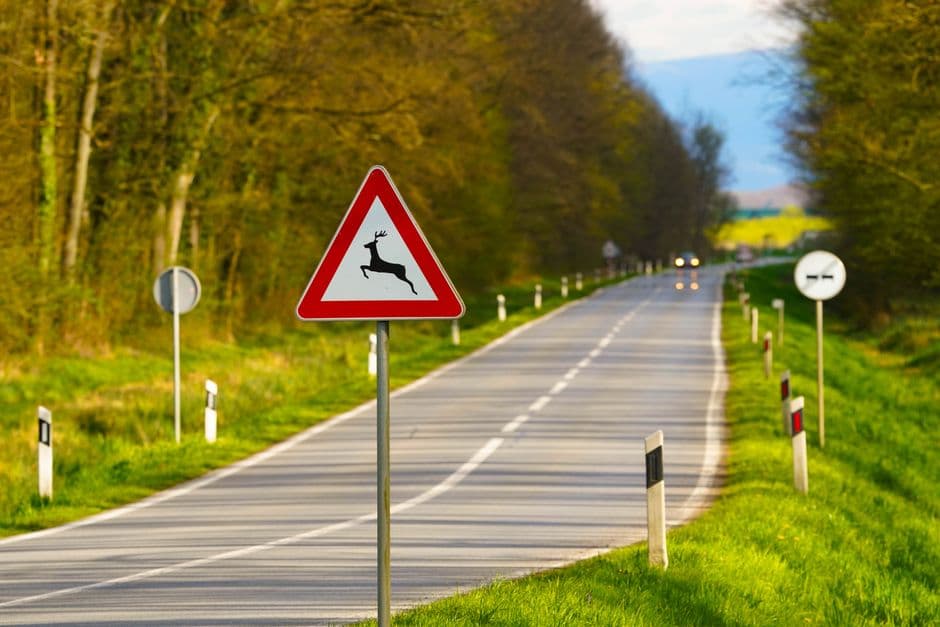
Deer-crossing signs deserve attention, but deer do not read signs. Use the signs as a reminder to slow your pace and widen your view.
Dawn and dusk are the big watch periods. The Game Commission also notes that the end of daylight-saving time puts more commuter traffic on the road during those peak deer-activity hours (Pennsylvania Game Commission). In local terms, that can mean a darker drive on Route 22, I-81 approaches, I-78, PA Turnpike ramps, or two-lane roads between fields and tree lines.
Deer-crossing signs deserve attention, but deer do not read signs. Use the signs as a reminder to slow your pace and widen your view.
When you see one deer, look for the next one
One deer crossing is not the all-clear. PennDOT and the Game Commission both point out that deer commonly move in groups, and the Game Commission notes they often travel single file (PennDOT, Pennsylvania Game Commission).
A practical driver reaction looks like this:
AAA advises scanning the road and shoulders far ahead to increase reaction time for animal hazards (AAA). At night, high beams can help you spot wildlife sooner when there is no oncoming traffic, but switch them down when they would glare another driver (AAA).
A practical driver reaction looks like this:
- Ease off the accelerator.
- Check mirrors so you know what is behind you.
- Cover the brake and slow smoothly.
- Watch both shoulders and the ditch line.
- Do not speed back up just because the first deer made it across.
AAA advises scanning the road and shoulders far ahead to increase reaction time for animal hazards (AAA). At night, high beams can help you spot wildlife sooner when there is no oncoming traffic, but switch them down when they would glare another driver (AAA).
If hitting a deer looks unavoidable
This is the part people do not like to think about, but it matters. AAA advises drivers to brake firmly and stay in the lane if an animal collision cannot be avoided, rather than swerving (AAA).
In plain English: swerving may trade a deer strike for a loss of control, oncoming traffic, a ditch, a tree, or a rollover risk. Braking in your lane is usually the more controlled choice when there is no clean escape path.
That does not mean you should aim for the animal. It means your first job is to keep the vehicle as controlled as possible. Firm braking, eyes forward, and staying in your lane gives you the best chance to manage what happens next.
In plain English: swerving may trade a deer strike for a loss of control, oncoming traffic, a ditch, a tree, or a rollover risk. Braking in your lane is usually the more controlled choice when there is no clean escape path.
That does not mean you should aim for the animal. It means your first job is to keep the vehicle as controlled as possible. Firm braking, eyes forward, and staying in your lane gives you the best chance to manage what happens next.
Vehicle prep that actually fits deer-season driving
Maintenance cannot promise that you will avoid a deer. What it can do is remove preventable problems from the situation. For fall deer season driving, focus on the systems that affect seeing, stopping, and control.
Before peak fall movement, check:
NextGen AutoWorks can help with routine maintenance, tire services, brake repair, electrical diagnostics, and steering and suspension repair when those concerns show up before fall driving.
Before peak fall movement, check:
- Headlights, brake lights, turn signals, and hazard lights
- Wipers and windshield clarity
- Tire condition and tire pressure; use the pressure listed on the vehicle placard or owner’s manual
- Brake feel, brake noise, and any brake warning light
- Steering looseness, pulling, vibration, or an off-center wheel
- Warning lights that need proper testing instead of guesswork
NextGen AutoWorks can help with routine maintenance, tire services, brake repair, electrical diagnostics, and steering and suspension repair when those concerns show up before fall driving.
After a deer strike in Pennsylvania
First, take care of people. If you can move the vehicle to a safer spot without forcing it, do that. If the shoulder or roadside location is unsafe, stay away from traffic and call roadside assistance or emergency services.
PennDOT’s release quotes Pennsylvania State Police guidance that police must be contacted if a deer-related crash involves injury or death, or if vehicle damage is severe enough that the vehicle cannot be driven from the scene (PennDOT). For a struck deer that is still alive, the Game Commission says to keep your distance and report it to the Game Commission or law enforcement if it does not leave or creates a public safety risk (Pennsylvania Game Commission).
Do not continue driving if the vehicle has leaking fluid, a brake warning symptom, severe vibration, steering changes, tire damage, smoke, an electrical burning smell, or parts dragging underneath. Those are inspection-before-continuing situations.
PennDOT’s release quotes Pennsylvania State Police guidance that police must be contacted if a deer-related crash involves injury or death, or if vehicle damage is severe enough that the vehicle cannot be driven from the scene (PennDOT). For a struck deer that is still alive, the Game Commission says to keep your distance and report it to the Game Commission or law enforcement if it does not leave or creates a public safety risk (Pennsylvania Game Commission).
Do not continue driving if the vehicle has leaking fluid, a brake warning symptom, severe vibration, steering changes, tire damage, smoke, an electrical burning smell, or parts dragging underneath. Those are inspection-before-continuing situations.
Frequently Asked Questions
What time of day are deer most active in Pennsylvania?
Dawn and dusk deserve the most attention, and fall driving after dark needs extra caution too. The Pennsylvania Game Commission identifies dawn and dusk as peak activity periods, with more deer movement in October, November, and December.
Should I swerve to miss a deer?
If a collision looks unavoidable, AAA advises braking firmly and staying in your lane instead of swerving. Swerving can create a larger loss-of-control problem, especially on dark rural roads or near oncoming traffic.
What vehicle checks matter most before deer season driving?
Focus on headlights and exterior lights, wipers, tire condition and pressure, brakes, steering, suspension, alignment symptoms, and warning lights. These checks do not prevent every deer strike, but they matter for visibility, braking, and control.
Can I drive home after hitting a deer?
Only if the vehicle is still controllable and not showing damage symptoms that make driving unsafe. Stop when safe and get help if there is leaking fluid, tire damage, steering change, brake concern, severe vibration, smoke, burning smell, or damage that keeps the vehicle from being driven from the scene.
routine maintenancetire servicesbrake repairelectrical diagnosticssteering and suspension repairschedule service
If your lights, tires, brakes, wipers, steering, or warning lights are not ready for fall driving, call NextGen AutoWorks in Grantville at (717) 473-5997 to schedule service.
deer season drivingnight driving safetyroutine maintenancebrakes lights tiresCentral PA driving