


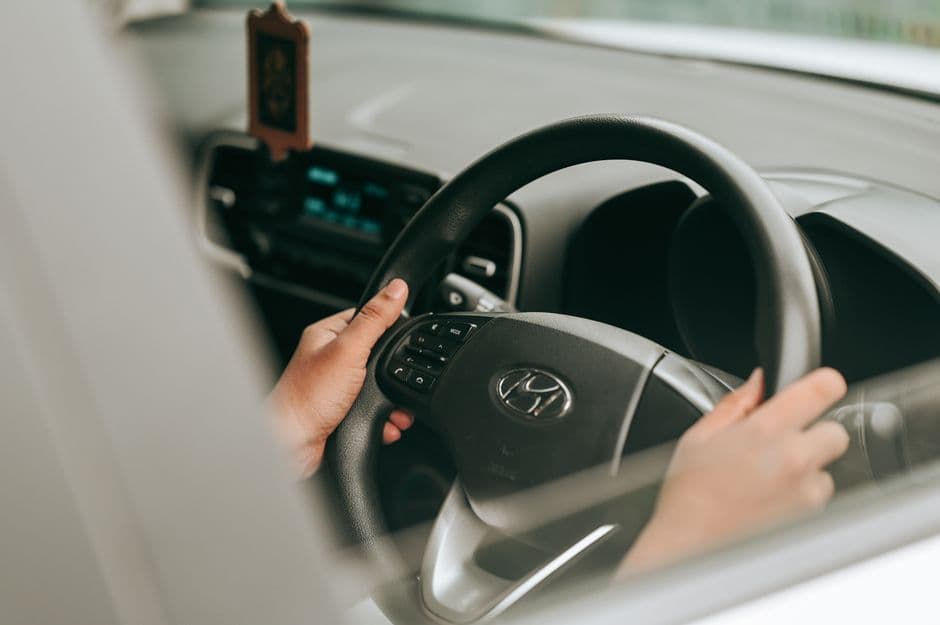
Why is my steering wheel crooked when I’m driving straight?
If the car tracks straight but the steering wheel has to sit a little left or right, that is usually called an off-center steering wheel. AAA lists a steering wheel cocked to one side while the vehicle travels straight as a possible misalignment symptom, along with pulling, uneven tire wear, and sometimes steering-wheel vibration (AAA).
That does not mean an alignment is automatically the whole answer. The first question is what the vehicle is actually doing:
Those details change the inspection path.
That does not mean an alignment is automatically the whole answer. The first question is what the vehicle is actually doing:
- Does it go straight only when you hold the wheel crooked?
- If you center the wheel, does the car drift left or right?
- Does it happen only on certain roads?
- Is there vibration, clunking, uneven tire wear, or a recent pothole hit?
Those details change the inspection path.
Off-center wheel, pull, torque steer, and road crown are different complaints
A true off-center steering wheel means the vehicle goes straight while the wheel sits at a slight angle. A pull or drift is different: you hold the wheel straight, and the car wants to move left or right. A NHTSA-hosted manufacturer bulletin makes that same distinction and says an off-center wheel should be diagnosed before correction (NHTSA-hosted bulletin).
Road shape matters too. Many roads are crowned or sloped so water runs off. On a crowned road, you may be counter-steering slightly without realizing it, which can make the wheel look off center. That is why diagnosis uses a straight, flat road concept, not one quick glance on a sloped lane.
Another NHTSA-hosted bulletin separates related symptoms this way: torque steer is pull during hard acceleration, steering pull is drift at speed with the wheel held straight, and steering off-center means the wheel must be held at an angle for the vehicle to go straight (NHTSA-hosted bulletin).
Road shape matters too. Many roads are crowned or sloped so water runs off. On a crowned road, you may be counter-steering slightly without realizing it, which can make the wheel look off center. That is why diagnosis uses a straight, flat road concept, not one quick glance on a sloped lane.
Another NHTSA-hosted bulletin separates related symptoms this way: torque steer is pull during hard acceleration, steering pull is drift at speed with the wheel held straight, and steering off-center means the wheel must be held at an angle for the vehicle to go straight (NHTSA-hosted bulletin).
Why potholes and rough Central PA roads matter
Around Grantville, Hershey, I-81, I-78, and the PA Turnpike, a sharp pothole or curb hit can do more than annoy you. AAA notes that alignment changes can come from curb or pothole impacts, rough-road driving, worn or neglected suspension parts, suspension height changes, and normal suspension wear (AAA).
A crooked wheel after an impact deserves more than a quick steering-wheel adjustment. The alignment may be off, but the impact may also have bent or loosened something, damaged a tire, or exposed wear in a ball joint, control arm, bushing, strut, wheel bearing, or CV axle.
That is why a Grantville steering repair visit should look at the parts that locate the wheel, not just the steering wheel position.
A crooked wheel after an impact deserves more than a quick steering-wheel adjustment. The alignment may be off, but the impact may also have bent or loosened something, damaged a tire, or exposed wear in a ball joint, control arm, bushing, strut, wheel bearing, or CV axle.
That is why a Grantville steering repair visit should look at the parts that locate the wheel, not just the steering wheel position.
Why it may not be a wheel balance problem
Wheel alignment and wheel balancing solve different problems. AAA explains that balancing deals with uneven weight distribution in the wheel and tire assembly, while alignment adjusts steering and suspension geometry so the wheels and tires sit correctly relative to the road and each other (AAA).
In plain English:
If your only symptom is an off center steering wheel with no vibration, asking only for balancing may miss the issue.
In plain English:
- A balance problem is more likely to show up as vibration, especially at highway speeds.
- An alignment or suspension issue is more likely when the steering wheel sits crooked, the vehicle pulls, or tire wear is uneven.
- A damaged or unevenly worn tire can confuse the picture, so the tires still need to be inspected.
If your only symptom is an off center steering wheel with no vibration, asking only for balancing may miss the issue.
What should be checked before calling it an alignment?
Before correcting an off-center wheel, the vehicle should be checked for tire and suspension conditions that can cause or imitate the symptom. A NHTSA-hosted bulletin points to tire placard pressures, even and symmetric tire wear, and signs of suspension component damage as part of the diagnosis (NHTSA-hosted bulletin). Use the tire pressure listed on the vehicle placard or owner’s manual, not the maximum number printed on the tire sidewall.
A practical inspection may include:
Toe matters here because it is tied to where the wheels point when the steering wheel is straight. AAA notes that incorrect toe can make tires scrub and wear inner or outer edges (AAA).
A practical inspection may include:
- Tire pressure and tire size match
- Uneven, irregular, inner-edge, or outer-edge tire wear
- Tire damage, bulges, or visible tread concerns
- Loose, worn, or damaged steering and suspension parts
- Wheel alignment angles: camber, caster, and toe
- Whether the steering wheel is centered during the alignment check
Toe matters here because it is tied to where the wheels point when the steering wheel is straight. AAA notes that incorrect toe can make tires scrub and wear inner or outer edges (AAA).
When should you stop driving or have it inspected?
Have the vehicle inspected before more normal driving if the crooked steering wheel appeared after a pothole or curb hit, is getting worse, or comes with pulling, uneven tire wear, clunks, steering looseness, or vibration. Steering and suspension are safety-critical systems, so guessing from the driver’s seat is not enough.
Stop when safe and seek help if:
For local service, steering and suspension repair may need to be paired with alignment checks, tire services, or an inspection if the concern overlaps with Pennsylvania requirements. Pennsylvania inspection outcome can only be determined by an actual inspection at an official inspection station.
Stop when safe and seek help if:
- The vehicle does not feel controllable
- Steering response changes suddenly
- Severe vibration starts
- A wheel or tire looks damaged
- The vehicle pulls hard enough that you are fighting the wheel
For local service, steering and suspension repair may need to be paired with alignment checks, tire services, or an inspection if the concern overlaps with Pennsylvania requirements. Pennsylvania inspection outcome can only be determined by an actual inspection at an official inspection station.
Frequently Asked Questions
Can I keep driving if the steering wheel is only a little crooked?
Maybe for a short local drive, but do not treat it as harmless. If it appeared suddenly, is getting worse, or comes with pulling, noise, severe vibration, tire damage, or loose steering, stop when safe and have it inspected before continuing.
Will an alignment fix an off center steering wheel?
An alignment may be part of the fix, especially if toe or another angle is out of adjustment. But tire condition, tire pressure, road crown, worn parts, or impact damage can also be involved, so the vehicle needs to be checked first.
How is this different from a tire balance problem?
Balancing is mainly tied to vibration from uneven weight in the wheel and tire assembly. A steering wheel that sits crooked while the car travels straight points more toward alignment, tires, or steering and suspension geometry.
Can a crooked steering wheel affect PA inspection?
Pennsylvania inspection results depend on the actual condition of the vehicle at an official inspection station. If the crooked wheel is related to worn suspension parts, tire damage, or steering concerns, it is worth addressing before inspection time.
If your steering wheel is off center after rough roads or a pothole hit, call NextGen AutoWorks in Grantville at (717) 473-5997 to schedule steering, suspension, tire, and alignment inspection.
steeringsuspensionalignmenttiresGrantville PA