


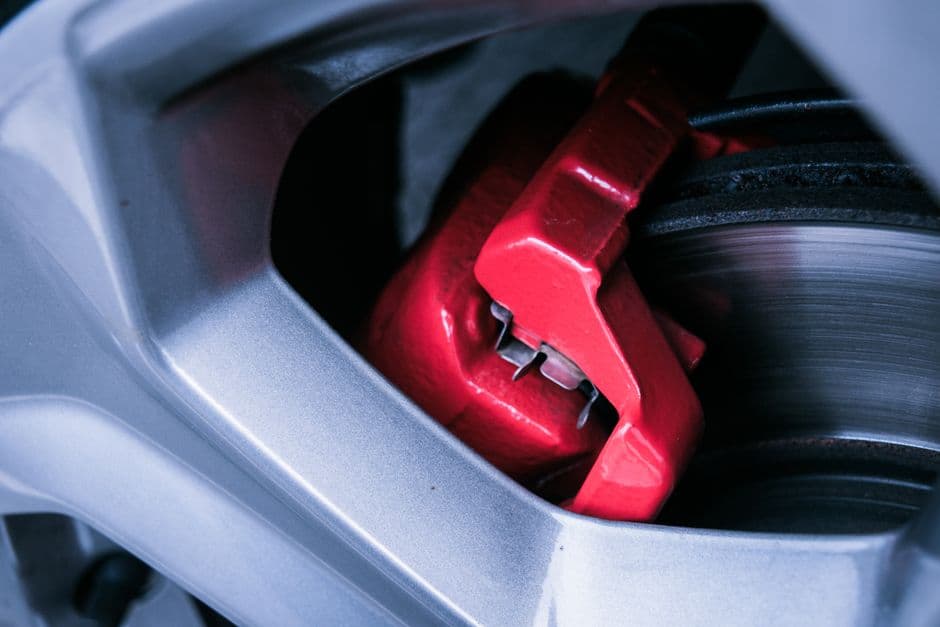
Why do my brakes smell hot after driving downhill or towing?
Brakes slow the vehicle by using friction between pads or shoes and rotors or drums. Friction makes heat. On a long downhill grade, gravity keeps trying to add speed, and a loaded vehicle or camper makes the brakes work harder to control it. FHWA explains that long or steep downgrades and heavier loads can build brake heat faster when the brakes are used too much (FHWA).
That hot, sharp, burning smell from brakes is often overheated friction material. AAA lists a burning smell as a braking-system warning sign and notes that overheated brakes can reduce braking effectiveness (AAA). So even if the smell fades after a few minutes, do not treat it as proof that everything is fine.
That hot, sharp, burning smell from brakes is often overheated friction material. AAA lists a burning smell as a braking-system warning sign and notes that overheated brakes can reduce braking effectiveness (AAA). So even if the smell fades after a few minutes, do not treat it as proof that everything is fine.
What brake fade feels like in plain English
Brake fade means the brakes are so hot that they do not respond the same way. PennDOT’s commercial driver guidance describes it as needing more pedal pressure to get the same stopping power, with continued overheating possibly reducing the ability to slow or stop (PennDOT CDL Manual).
Stop when safe and get help if you notice:
Do not push on to the next long hill if the brakes feel weaker. Let the vehicle sit in a safe place, stay clear of traffic, and arrange help if you are not comfortable continuing.
Stop when safe and get help if you notice:
- The pedal feels soft, lower, or different than usual
- The vehicle takes more distance to slow down
- The vehicle pulls while braking
- You feel severe shaking while braking
- You see smoke or a brake warning light
- The smell is strong after a descent and braking does not feel right
Do not push on to the next long hill if the brakes feel weaker. Let the vehicle sit in a safe place, stay clear of traffic, and arrange help if you are not comfortable continuing.
The driving habit that overheats brakes faster
The habit that cooks brakes on a grade is dragging the pedal lightly for a long time. That keeps heat going into the brakes without giving them much chance to cool.
A better approach, when your vehicle allows it, is to control speed before the grade gets away from you. FHWA guidance for downgrade driving supports choosing an appropriate lower gear before the descent, using the service brakes firmly enough to reduce speed, then releasing them so they can cool instead of riding them continuously (FHWA). Pennsylvania’s CDL guidance gives a similar method for commercial vehicles, but your passenger vehicle, truck, RV, or tow setup still needs to be driven according to its owner’s manual and manufacturer guidance (PennDOT CDL Manual).
For towing, also verify towing capacity, payload, tire pressure, hitch rating, tongue weight, and trailer brake requirements using your owner’s manual or manufacturer documentation. There is no one-size answer for every truck and camper.
A better approach, when your vehicle allows it, is to control speed before the grade gets away from you. FHWA guidance for downgrade driving supports choosing an appropriate lower gear before the descent, using the service brakes firmly enough to reduce speed, then releasing them so they can cool instead of riding them continuously (FHWA). Pennsylvania’s CDL guidance gives a similar method for commercial vehicles, but your passenger vehicle, truck, RV, or tow setup still needs to be driven according to its owner’s manual and manufacturer guidance (PennDOT CDL Manual).
For towing, also verify towing capacity, payload, tire pressure, hitch rating, tongue weight, and trailer brake requirements using your owner’s manual or manufacturer documentation. There is no one-size answer for every truck and camper.
When the smell points to a mechanical problem
A hot-brake smell after a hill may come from hard use, but the same smell can also point to a brake problem. If one brake is not doing its share, the others can carry more of the work, heat faster, and fade sooner. FHWA notes that uneven brake contribution can lead to extra heat in the remaining brakes (FHWA). PennDOT’s CDL material also explains that brakes out of adjustment can stop contributing before properly adjusted brakes, which makes the other brakes overheat faster (PennDOT CDL Manual).
An inspection is what separates these possibilities:
You cannot diagnose those from odor alone at the side of the road.
An inspection is what separates these possibilities:
- Pads or shoes worn down or heat-damaged
- Rotor or drum problems
- A caliper that is sticking or not releasing correctly
- A parking brake that is dragging
- Brake fluid or hydraulic concerns
- ABS-related faults
- Trailer brake or brake-controller concerns when towing
You cannot diagnose those from odor alone at the side of the road.
Towing a camper in Central PA adds another source of heat
If you are coming through Dauphin County or Lebanon County with a camper, the smell may not be only from the tow vehicle. Some trailer brake systems create braking force when the tow vehicle slows and trailer momentum activates the brake actuator, so trailer brakes can also generate heat and odor after a downhill pull. A NHTSA-hosted Dexter document explains that concept for its surge-style trailer disc brakes, and also notes that downhill towing adds stress to both tow-vehicle and trailer brakes (NHTSA-hosted Dexter document).
If the trailer feels like it is pushing, pulling, veering, or not staying straight, stop safely and investigate before continuing. If the tow vehicle or trailer brakes feel hot or show fade, the same Dexter document says to stop and let the brakes cool before continuing. Do not try to cool hot brake parts with water; rapid cooling can stress components.
If the trailer feels like it is pushing, pulling, veering, or not staying straight, stop safely and investigate before continuing. If the tow vehicle or trailer brakes feel hot or show fade, the same Dexter document says to stop and let the brakes cool before continuing. Do not try to cool hot brake parts with water; rapid cooling can stress components.
Brake service in Grantville before the next hill or trip
Summer trips to Hershey, I-81, I-78, the PA Turnpike, and nearby campgrounds are easier to enjoy when the brake system is not a question mark. NHTSA says road trips are a good time for vehicle checks before travel (NHTSA), and the Car Care Council recommends regular brake inspections and checking with a mechanic or owner’s manual when a vehicle has an odd smell (Car Care Council).
NextGen AutoWorks offers brake repair, including brake inspections, pad and shoe replacement, rotor service, brake fluid service, brake line inspection, caliper service, and ABS diagnostics. If towing is part of the concern, RV repair and hitch installation can also include RV maintenance, hitch installation, brake controllers, trailer wiring, and weight distribution setup where appropriate.
NextGen AutoWorks offers brake repair, including brake inspections, pad and shoe replacement, rotor service, brake fluid service, brake line inspection, caliper service, and ABS diagnostics. If towing is part of the concern, RV repair and hitch installation can also include RV maintenance, hitch installation, brake controllers, trailer wiring, and weight distribution setup where appropriate.
Frequently Asked Questions
Can I keep driving if the hot brake smell goes away?
Not automatically. If the pedal feels different, braking feels weaker, the vehicle pulls, there is smoke, or a warning light is on, stop when safe and call for help. If the smell happened after a hard downhill grade or towing, have the brakes inspected before another long descent.
Is a burning smell from brakes the same as brake fade?
Not always. The smell can be a warning that the brakes got very hot, while brake fade is the loss of braking response from heat. You can have odor before you clearly feel fade, which is why the smell should be taken seriously.
Could the trailer brakes be the source of the smell?
Yes. When towing, heat and odor can come from the tow vehicle, the trailer, or both. Trailer brake design varies, so use the trailer and tow-vehicle documentation and have the setup inspected if the trailer is pushing, pulling, veering, or the brakes feel hot.
If your brakes smell hot after a downhill drive or while towing, do not guess from the smell alone. Call NextGen AutoWorks in Grantville at (717) 473-5997 to schedule brake service or a towing-related inspection.
brakestowingroad trip safetyCentral PA